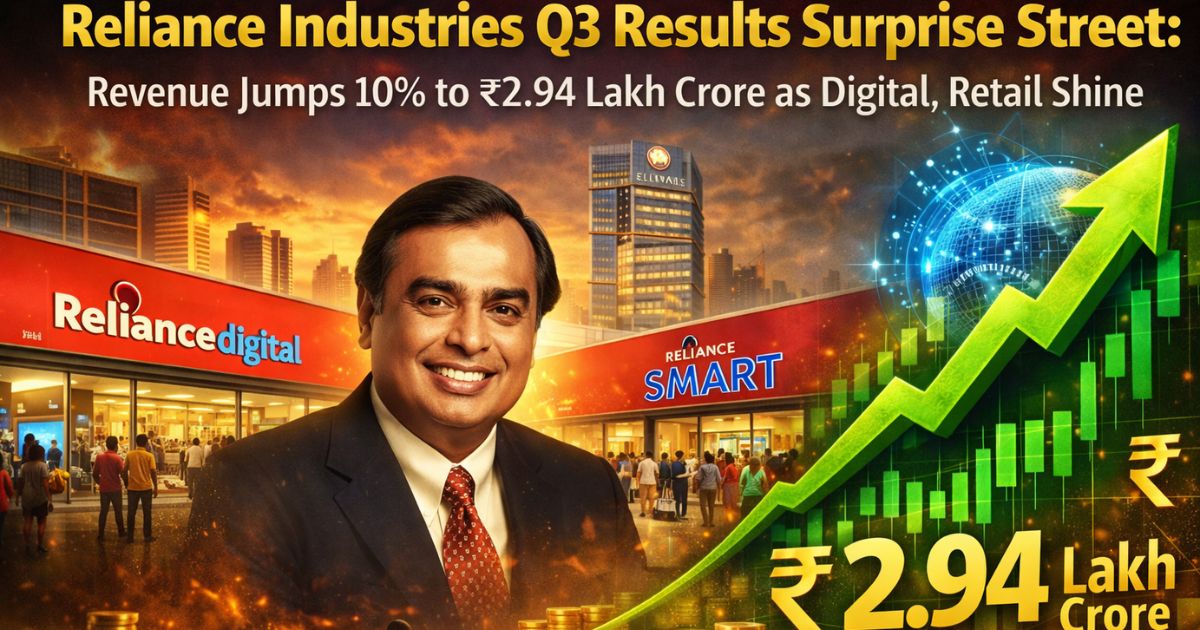
India’s most valuable company, Reliance Industries Limited (RIL), has delivered a solid set of numbers for the October–December quarter (Q3 FY26), underscoring the strength of its diversified business model. Driven by robust performance in digital services, retail, and the oil-to-chemicals (O2C) business, Reliance posted double-digit revenue growth, even as the oil and gas segment remained under pressure.
Reliance Industries Q3 FY26 Financial Performance
Reliance Industries reported total revenue of ₹2.94 lakh crore in Q3 FY26, marking a 10% year-on-year increase compared with ₹2.67 lakh crore in the same quarter last year. The growth reflects sustained momentum across consumer-facing and refining-linked businesses.
Net profit for the quarter rose modestly by 1.6% year-on-year to ₹22,290 crore, while profit before tax increased 3.7% to ₹29,697 crore. The company’s consolidated EBITDA climbed 6.1% to ₹50,932 crore, supported mainly by digital services and O2C operations.
Reliance Industries Q3 FY26
| Particulars | Q3 FY26 |
|---|---|
| Revenue | ₹2.94 lakh crore |
| Net Profit | ₹22,290 crore |
| Profit Before Tax | ₹29,697 crore |
| EBITDA | ₹50,932 crore |
O2C Business Powers Earnings Growth
Reliance’s oil-to-chemicals (O2C) business emerged as a major earnings driver during the quarter. The segment benefited from a sharp improvement in transportation fuel cracks, which rose between 62% and 106% on a year-on-year basis. This favourable refining environment helped O2C EBITDA grow 15% to ₹16,507 crore, reflecting better margins and strong operational flexibility.
Mukesh Ambani highlighted that the strong O2C performance was backed by improved demand-supply dynamics and the company’s ability to optimise operations amid volatile energy markets.
Digital and Retail Businesses Remain Key Pillars
Reliance’s digital services and retail businesses continued to provide stability and growth to the overall earnings profile. These segments played a crucial role in supporting consolidated EBITDA, reinforcing Reliance’s long-term strategy of building strong consumer-facing platforms alongside its legacy energy businesses.
Jio-bp Fuel Retailing Maintains Strong Momentum
The Jio-bp fuel retailing joint venture sustained its growth trajectory in Q3 FY26. Higher gasoline and high-speed diesel sales drove a 24% increase in fuel volumes. Network expansion also continued at a steady pace, with 2,125 Jio-bp outlets operational by the end of December, reflecting a 14% year-on-year increase.
Mukesh Ambani noted that the expanding Jio-bp network and rising fuel demand are contributing meaningfully to Reliance’s downstream growth strategy.
Oil and Gas Segment Weighs on Overall Performance
While most segments performed well, the oil and gas business remained a drag on consolidated performance. Production was impacted by natural decline in the KG-D6 block reservoirs, lower realised prices, and higher operating costs due to maintenance activities. As a result, the segment’s EBITDA declined 13% year-on-year to ₹4,857 crore, while revenue fell 8.4% to ₹5,833 crore.
Management Commentary Reflects Confidence
Commenting on the results, Mukesh Ambani, Chairman and Managing Director of Reliance Industries, said the Q3 FY26 performance demonstrates consistent financial delivery and operational strength across businesses. He expressed confidence in the company’s ability to navigate challenges in the energy segment while capitalising on growth opportunities in consumer and digital businesses.
Final Takeaway
Reliance Industries’ Q3 FY26 results highlight the power of diversification. While the oil and gas segment faced headwinds, strong growth in digital services, retail, and O2C ensured healthy revenue and EBITDA expansion. With improving refining margins and continued momentum in consumer businesses, Reliance appears well-positioned to sustain growth, even amid sector-specific challenges.
Disclaimer: This article is for informational purposes only and does not constitute investment advice.